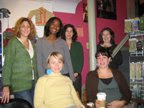
Every day from December 1 through December 10, we’re going to offer a brief introduction to some technique that we think every knitter should know—at no charge. Stop by and add a couple new tricks to your bag. (Note that the times vary--wildly. We hope everyone will find at least a couple that are convenient.)
1. M1L and M1R Thurs. 12/1 at 11 M1 is the smoothest, closest-to-invisible increase you’ll find. Now learn how to do it two ways, so that you can make paired increases perfectly symmetrical.
2. Winding a Butterfly Fri. 12/2 at 11 Keeps your cast-on “tail” out of the way while you knit, or keeps your intarsia tidy—without bobbins.
3. Making and Attaching Fringe Sat. 12/3 10:30 Where would scarves be without it?
4. 3-Needle Bind-Off Sun. 12/4 at 12:30 Shoulder seams will always come out smooth and even; afghan panels can be seamed without sewing.
5. Channel-Island Cast-On Mon. 12/5 at 3:30 Good elasticity, and gives the appearance of a 1x1 rib—perfect for sock cuffs.
6. Suspended Bind-Off Tues. 12/6 at 11:30 Keeps things loose and even without using a larger needle, and flows more smoothly.
7. Reading Charts Wed. 12/7 at 4:30 Don’t be intimidated; it’s the wave of the future.
8. Provisional Cast-on Thurs. 12/8 at 3:30 Put stitches on your needle—and then get them back again later to work in the opposite direction.
9. Duplicate Stitch Fri. 12/9 at 3:30 Use a darning needle to create patterns that look knitted-in.
10. Weaving In as You Go Sat. 12/10 at 10:30 Work in all your loose yarn tails long before you get to the finishing stage.
Tuesday, November 29, 2005

Sunday, November 27, 2005
Bah, Humbug: First In a Series?
The holiday shopping season is now officially upon us. While the especially clever of you have been knitting gifts for weeks or months already, the rest are beginning to consider the situation. This isn't going to be one of those posts in which I lecture anyone about leaving things til the last minute (me, of all people!), nor am I going to offer any brilliant suggestions for last-minute knitted gifts (not right now, anyway). Instead, I'm going to ask a contrarian question: why are you knitting gifts?
I don't mean to suggest that you shouldn't. I just want you to take stock for a moment and consider why you do. There are lots of good reasons--knitting someone a gift is a wonderful opportunity to show them how well you know them and how much you care, not to mention giving you a chance to work with yarns or colors you may not have tried before, a chance to show off a bit, and possibly a chance to save some money.
But I've seen lots of knitters who don't seem all that enthusiastic about the gifts they're preparing to knit. There are telltale signs: the knitter who starts out saying, "I want something really luxurious" but then complains if the cost of materials is going to be more than $15; the knitter who says repeatedly, "I love this color, but she wouldn't"; the knitter who wants something "conservative" or "refined" but then grimaces every time a needle size below 10 is mentioned. These are all signs of hidden (or not-so-hidden) resentment: for one reason or another, the gift-maker wishes she could avoid this project.
So I've been puzzled: If you don't want to knit this person a gift, why do it? I never have the nerve to ask "It sounds like you're kind of ambivalent about this person; have you considered whether you should be knitting for them at all?" After all, I'm the shopkeeper, not the therapist. But I listen closely to the clues people give, and I'm surprised how often I hear traces of something like emotional coercion: "It's for my husband's assistant;" "It's for my boyfriend's sister."
Sometimes a knitted gift may be the best option, even if you're not totally enthusiastic. But please, if that's not the case in your life--if someone has said to you, totally casually, "Hey, that's a cute scarf; knit one for my mom, o.k.?"--consider standing up and saying, "Do you have any idea how much time and effort that is? When I'd rather be working on a project I love, for myself or for you? Let's buy a gift."
It's our job to educate non-knitters (if we don't, who will?). Not just for your own sake, but for the sake of knitters everywhere, make sure your nearest and dearest understand what a knitted gift involves. And remember that, just as life is too short to knit with bad yarn, life is too short to knit projects you're not really into.
P.S. Another thing I've noticed: if you've gotten suckered into knitting a gift you're not keen on, buying yourself a set of exotic-hardwood needles from Lantern Moon for the job helps take some of the sting away.
I don't mean to suggest that you shouldn't. I just want you to take stock for a moment and consider why you do. There are lots of good reasons--knitting someone a gift is a wonderful opportunity to show them how well you know them and how much you care, not to mention giving you a chance to work with yarns or colors you may not have tried before, a chance to show off a bit, and possibly a chance to save some money.
But I've seen lots of knitters who don't seem all that enthusiastic about the gifts they're preparing to knit. There are telltale signs: the knitter who starts out saying, "I want something really luxurious" but then complains if the cost of materials is going to be more than $15; the knitter who says repeatedly, "I love this color, but she wouldn't"; the knitter who wants something "conservative" or "refined" but then grimaces every time a needle size below 10 is mentioned. These are all signs of hidden (or not-so-hidden) resentment: for one reason or another, the gift-maker wishes she could avoid this project.
So I've been puzzled: If you don't want to knit this person a gift, why do it? I never have the nerve to ask "It sounds like you're kind of ambivalent about this person; have you considered whether you should be knitting for them at all?" After all, I'm the shopkeeper, not the therapist. But I listen closely to the clues people give, and I'm surprised how often I hear traces of something like emotional coercion: "It's for my husband's assistant;" "It's for my boyfriend's sister."
Sometimes a knitted gift may be the best option, even if you're not totally enthusiastic. But please, if that's not the case in your life--if someone has said to you, totally casually, "Hey, that's a cute scarf; knit one for my mom, o.k.?"--consider standing up and saying, "Do you have any idea how much time and effort that is? When I'd rather be working on a project I love, for myself or for you? Let's buy a gift."
It's our job to educate non-knitters (if we don't, who will?). Not just for your own sake, but for the sake of knitters everywhere, make sure your nearest and dearest understand what a knitted gift involves. And remember that, just as life is too short to knit with bad yarn, life is too short to knit projects you're not really into.
P.S. Another thing I've noticed: if you've gotten suckered into knitting a gift you're not keen on, buying yourself a set of exotic-hardwood needles from Lantern Moon for the job helps take some of the sting away.
Wednesday, November 23, 2005
Gratitude: Our Anniversary and Our Customers
Believe it or not, Rosie's Yarn Cellar is celebrating its 10th Anniversary in just a few days! The greeting card industry tells us that the appropriate symbols of the 10th anniversary are (for traditionalists) aluminum & tin, and (for modernists) diamonds. I wanted to discount Susan Bates Knit-Cheks and aluminum-coated knitting needles in honor of this special occasion; but thankfully Lisa Myers is in charge, and she has way better stuff planned. So stay tuned. We'll post more information here about upcoming anniversary events and we'll be sending out the December e-newsletter (and drawing prizes) too.
We are very pleased to have been your LYS for ten years and we hope to be here for many, many more. In honor of Turkey Day, we say to all our loyal, enthusiastic, creative customers: Thank you! Have a happy Thanksgiving filled with good things.
We are very pleased to have been your LYS for ten years and we hope to be here for many, many more. In honor of Turkey Day, we say to all our loyal, enthusiastic, creative customers: Thank you! Have a happy Thanksgiving filled with good things.
Monday, November 21, 2005
Lucy Review
So I missed Lucy’s workshop (someone has to mind the store!), but at Knitting Circle that evening, I got to look at a whole trunkful of her work. Hoo boy: she makes me feel like I should pack it in, since I’m not a serious knitter. I mean, every detail of every item is interesting: no cast-on is ever random, no odd-shaped space is unembellished (the gussets on her socks have their own patterns!). On top of that, everything everywhere is meticulously done—I just can’t bring myself to put that kind of time and energy into finishing—even though I know it would make my work look much better.
Perhaps we all admire most the people who do well what we do not. I stand in awe of the million woven-in ends. But most of all, I’m overwhelmed by the appearance that Lucy has never knit for a deadline in her life: there are clever tricks everywhere in her work to make the process easier or more pleasant, but never any sign of a shortcut. Every single piece testifies that anything worth knitting is worth knitting well, however long it takes.
It would be easy to say that there are certain constraints on my knitting that force me to hurry: I have this shop to tend, which not only makes me short of knitting time, it pressures me to produce as many projects to showcase as many yarns as possible. But that’s a copout; Lucy’s a professional designer and itinerant teacher, which means that there are competing claims on her time as well, and that she too has reasons to want to produce as many new items as is feasible. But there are no signs of hurry anywhere.
Don’t let this make you think that all her designs are year-long masterpieces. Some are. But plenty of the socks and hats are no more time-consuming than any others—she’s just put in all the time and energy to make sure that the patterns are as good as they can possibly be, so they’ll run smoothly for knitters like you and me.
I bow before a master of the craft.
Perhaps we all admire most the people who do well what we do not. I stand in awe of the million woven-in ends. But most of all, I’m overwhelmed by the appearance that Lucy has never knit for a deadline in her life: there are clever tricks everywhere in her work to make the process easier or more pleasant, but never any sign of a shortcut. Every single piece testifies that anything worth knitting is worth knitting well, however long it takes.
It would be easy to say that there are certain constraints on my knitting that force me to hurry: I have this shop to tend, which not only makes me short of knitting time, it pressures me to produce as many projects to showcase as many yarns as possible. But that’s a copout; Lucy’s a professional designer and itinerant teacher, which means that there are competing claims on her time as well, and that she too has reasons to want to produce as many new items as is feasible. But there are no signs of hurry anywhere.
Don’t let this make you think that all her designs are year-long masterpieces. Some are. But plenty of the socks and hats are no more time-consuming than any others—she’s just put in all the time and energy to make sure that the patterns are as good as they can possibly be, so they’ll run smoothly for knitters like you and me.
I bow before a master of the craft.
Sunday, November 20, 2005
Attention: we want you to get our e-newsletter so we're having a drawing
If you aren't yet on our newsletter list, and you somehow managed to ignore my last request that you email me soI can add you to our emailing list, here's another good reason to do it soon.
As part of our 10th Anniversary extravaganza (Lisa will tell you more about this very soon), we will be randomly selecting individuals on our emailing list to receive free prizes. If you aren't on the emailing list, you can't win when we make our random selection, can you? No, you can't. So drop me an email at carolATrosiesyarncellarDOTcom before midnight November 30th, 2005, and I will add you. You will receive our monthly newsletter AND be eligible for the prize drawing. Fine print: you have to provide us with a working email address (which is only fair, since we can't contact you to tell you that you won if your emails are bouncing).
As part of our 10th Anniversary extravaganza (Lisa will tell you more about this very soon), we will be randomly selecting individuals on our emailing list to receive free prizes. If you aren't on the emailing list, you can't win when we make our random selection, can you? No, you can't. So drop me an email at carolATrosiesyarncellarDOTcom before midnight November 30th, 2005, and I will add you. You will receive our monthly newsletter AND be eligible for the prize drawing. Fine print: you have to provide us with a working email address (which is only fair, since we can't contact you to tell you that you won if your emails are bouncing).
Saturday, November 19, 2005
Lookie, lookie!
Okay, I apologize for the blurry photography. (New camera. Still don't know how to use it yet.)

But this is what the back storeroom of Rosie's looked like yesterday, right after the UPS man delivered about seven boxes full of -- you guessed it -- yarn.

The first photo shows some of the fun new colors that we got in Nature Wool. The turquoise color on top is eye-catching, and a fuschia caught my eye, but there were also some more muted tones that were lovely. The second photo, to the extent you can make anything out (note to self: learn how to FOCUS!!!), is more Naturewool, plus Debbie Bliss Alpaca Silk and Alpaca Silk DK. Yep, we're restocked on the original, heavier weight and got in some of the lighter DK weight, too. Great drape, soft as a kitten, luscious colors, nicely priced. Life is good.

But this is what the back storeroom of Rosie's looked like yesterday, right after the UPS man delivered about seven boxes full of -- you guessed it -- yarn.
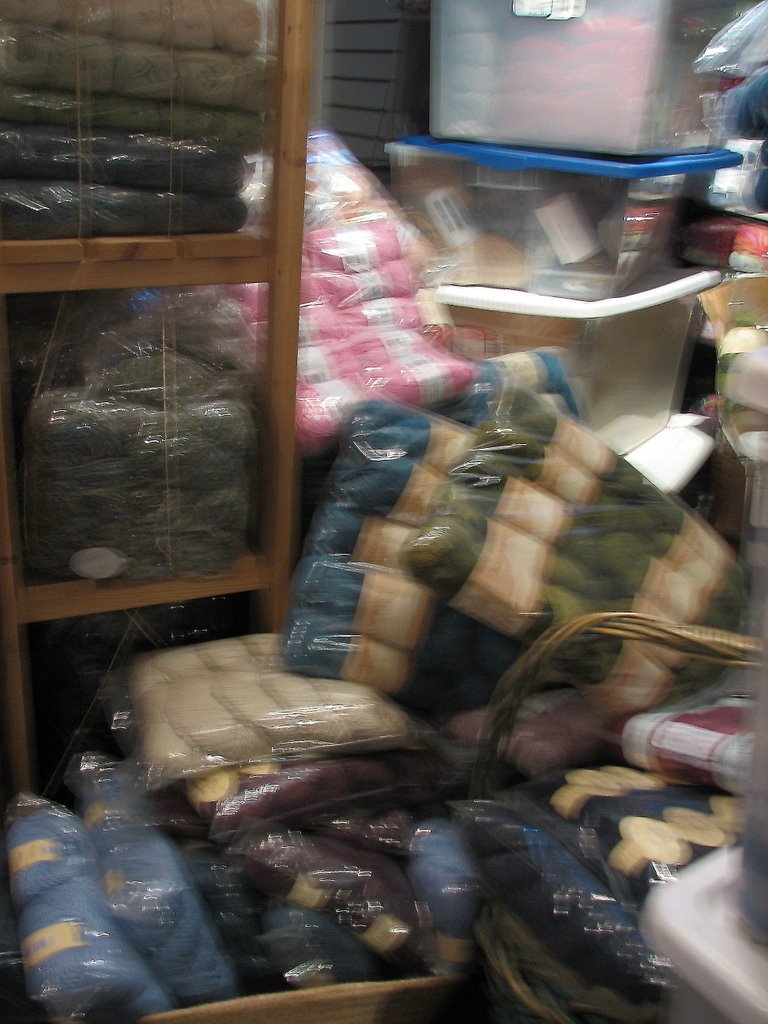
The first photo shows some of the fun new colors that we got in Nature Wool. The turquoise color on top is eye-catching, and a fuschia caught my eye, but there were also some more muted tones that were lovely. The second photo, to the extent you can make anything out (note to self: learn how to FOCUS!!!), is more Naturewool, plus Debbie Bliss Alpaca Silk and Alpaca Silk DK. Yep, we're restocked on the original, heavier weight and got in some of the lighter DK weight, too. Great drape, soft as a kitten, luscious colors, nicely priced. Life is good.
Tuesday, November 15, 2005
One Good Reason. Sort Of.

Awhile back (it was the last post in September. I don't know how to make a link here yet), I was wondering about people's tendency to buy more yarn than they need. And I kind of felt that, even in the case of hand-dyed yarn, where you'll probably never see another one just like it, we should all just take a deep breath and step back. That, even though we won't see one just like it, we could maybe learn to have faith that the next one that comes along will also be beautiful. Equally beautiful, probably, in its own way.
I'm not exactly retracting those comments. But, in talking with my new colleague Jennifer about Anne (and people's tendency to hoard it), I had another thought. For most of us, most of what we see/use/buy every day is mass-produced. This may be the last pair of size 8 sneakers on the shelf, but somewhere, there are plenty more just like it. But hand-dyed yarn isn't like that (especially since most hand-dyers got into this business because they like playing with color, not looking at the same thing day after day). And I wonder if maybe people's fascination (not to say obsession) with certain hand-dyed yarns isn't so much a sign of anxiety about scarcity, but rather a deep, even visceral attraction to something that's the opposite of mass-produced. We're knitters, after all; we like things that are unique, even if just because we made them. Maybe we want to attach ourselves to one-of-a-kind yarns because they're emblematic of everything we love about knitting -- and everything we don't love about shopping at the mall.
Just a thought. Here's another:

Diana likes to feel that she's helping out around here. Yesterday she made this sign, and taped it to the outer doorframe (at about knee-height, but still). She was fascinated by the idea that Lucy's hair could be sometimes pink, and sometimes purple, and sometimes both. I hope she gets to meet her.
(Lucy's flight gets in a couple hours from now. When she called yesterday to confirm travel details, I asked her, since I didn't yet know who'd be meeting her at the airport and how they'd recognize her, what color her hair is. She responded, "Well, I haven't decided yet.")
Monday, November 14, 2005
Got newsletter?
We're in the midst of updating our RYC e-mailing list, so if you haven't been getting our monthly on-line newsletter and other special updates from the shop, and if you'd like to, just shoot me an e-mail at carolATrosiesyarncellarDOTcom. (Just substitute @ for AT and . for DOT, otherwise the spammers will harvest my e-mail addy....) Of course we'll never sell your name or e-mail address to anybody; we'll use it only to send you our newsletter and other updates. It's a great way to keep up with new class schedules, learn about new yarns and books, and hear about special events.
Friday, November 11, 2005
Top 10 Things I Learned from Dorlynn

1. The many uses of eyeless safety pins.
2. If it isn't right, do it over. Again and again. And again. Until it's right.
3. Meticulous finishing can make even an unattractive garment look better.
4. Who Catherine Lowe is.
5. 101 ways to wear a scarf.
6. When selecting yarn for a project, lay out all the colors under the Ott light, and arrange them proportionally (so that you let only a wee bit of the accent colors peek out lest they overwhelm the main colors, and you use, say, 2 skeins of the main color to figure out how it looks with lots of that color).
7. A bath in a dilute solution of cold water with hair conditioner does wonders for a scratchier-than-desired yarn.
8. Lace, lace, lace.
9. The joys of little zip mesh bags.
10. Don't take your picture in one of those little booths in the middle of the RYC Christmas party. Especially after a margarita or two.
Wishing you well, Dor. The Saturday Crew won't be the same without you.
Wednesday, November 02, 2005
Is One Socka Color Better Than the Rest?
Here are Ed and Dorlynn playing footsie. It's not something they do that often, but then they looked down and realized that they were wearing socks from the same color of the same yarn:

It used to be Socka; now it's Fortissima Socka Colori; either way, it's still 2419 Kolibri. (Which I'm told means "hummingbird" in German.)
There was a period of a year or more when it was unavailable--not because it was discontinued and then brought back by popular demand. No, it was backordered for a year. We were told that the guy in Europe who dyes the stuff--"the guy," I'm telling you, not "the team" or "the division"--was ill for several months. Now, when I look at yarn with a mass-produced label, I think of it as mass-produced yarn, not something like artisanal goat cheese. How can there be only one guy who knows how to make the stuff?
These are the mysteries of the knitting world. Ed's pair of socks got cut in half by the hiatus: we had one 50-gram skein, I said, "Go ahead, no problem, we'll order more," and then . . . .
But that's all water under the bridge now. It's in 100-g skeins now, so if we have one, your pair is safe.
Ed and Dorlynn, by the way, have swapped status: Ed's crossed the great divide to become a member of the staff (look for him on Friday particularly), and Dorlynn has returned to civilian life, and can now enjoy Knitting Circle in (relative) peace. There are several other new members of the crew; we'll try to get them to submit to photos, and do some introductions in this space in the next few weeks.
It used to be Socka; now it's Fortissima Socka Colori; either way, it's still 2419 Kolibri. (Which I'm told means "hummingbird" in German.)
There was a period of a year or more when it was unavailable--not because it was discontinued and then brought back by popular demand. No, it was backordered for a year. We were told that the guy in Europe who dyes the stuff--"the guy," I'm telling you, not "the team" or "the division"--was ill for several months. Now, when I look at yarn with a mass-produced label, I think of it as mass-produced yarn, not something like artisanal goat cheese. How can there be only one guy who knows how to make the stuff?
These are the mysteries of the knitting world. Ed's pair of socks got cut in half by the hiatus: we had one 50-gram skein, I said, "Go ahead, no problem, we'll order more," and then . . . .
But that's all water under the bridge now. It's in 100-g skeins now, so if we have one, your pair is safe.
Ed and Dorlynn, by the way, have swapped status: Ed's crossed the great divide to become a member of the staff (look for him on Friday particularly), and Dorlynn has returned to civilian life, and can now enjoy Knitting Circle in (relative) peace. There are several other new members of the crew; we'll try to get them to submit to photos, and do some introductions in this space in the next few weeks.
Tuesday, November 01, 2005
Where do I find these things?
If the knitted zombies weren't outre enough for you, how about this? Exacting in its attention to detail.
Monday, October 31, 2005
Zephyr Scarf, Quick
Awhile back, I promised more about my Zephyr Scarf:

Here are the specs: It's maybe 42" long and about 10" wide. I used Jaggerspun Zephyr, which is 50% silk and 50% merino wool and about 5000 yards per pound. "Yards per pound," or ypp, is weaver-talk for yarn weight. In this case, it means "pretty darn skinny," as in, US #2 needles and a gauge of about 10 sts per inch.
I bought the yarn at Stitches East (which back then was just called Stitches) in about 1992. It was the same year I took a workshop with Susie Hodges on knitting fairisle patterns two-handed--that is, one strand in the left and one strand in the right. Sandy Terp, of Moonrise Designs, was selling little bits and pieces of Zephyr tied together on strings--maybe half an ounce of each of 5 or 6 colors for $5. I bought two, both in the blue/green family.
I used a 16" circular needle and cast on something like 160 sts (or it may have been 180*), and began knitting in the round. I had also bought a used copy of Alice Starmore's Book of Fair Isle Knitting, which is my favorite fairisle book, specifically because of the pattern library chapter. It has dozens and dozens of charted patterns, sorted into groups based on size--single-row patterns, two-row patterns, etc., on up to large snowflakes and stars. I started playing with the smaller border patterns and the colors I had. At 20" or a little before, I decided that I wanted to use each pattern only once. Within 4", I made a mistake, and reused a pattern that I'd used only a few inches before--an incredibly simple pattern, at that. I didn't realize until much later, and I sure wasn't going back.
The patterns fell into a rhythm: a very narrow pattern, then a medium-width pattern, then another very narrow one, then a slightly larger one--then repeat. Progress was not especially swift. By about February, I realized that I was running out of the color I liked best. I wrote to Sandy and enclosed a snip of the yarn--remember, these windings didn't even have labels--and she sent me more. I kept going.
I tried to finish the scarf in time for the next Stitches, in the hope of showing it to Susie Hodges, but I missed. She still liked it on the needles. I finished it the following night by staying up until morning and deciding that where I was was long enough. I bound off, then flattened the tube with the round-beginning at one edge, and sewed the top and bottom edges shut. Presto! No need to weave in 100,000 ends.
The scarf is very soft and very warm. I don't know any other yarn that's fine enough for this job--remember, the fairisle patterning makes the fabric almost twice as thick as single-color, and the tube doubles the thickness again, and the finished thing has to go around the neck without strangling the wearer--that has anything like this color range. There aren't many projects I've made that I'm just about totally satisfied with. This is one.
And that's the story of the Zephyr scarf.
*I'm guessing here, because the scarf is at home and I'm not. 160 or 180 was chosen because it had so many good factors--that is, a 4-stitch repeat would work, a 6-stitch repeat would work, etc.
Here are the specs: It's maybe 42" long and about 10" wide. I used Jaggerspun Zephyr, which is 50% silk and 50% merino wool and about 5000 yards per pound. "Yards per pound," or ypp, is weaver-talk for yarn weight. In this case, it means "pretty darn skinny," as in, US #2 needles and a gauge of about 10 sts per inch.
I bought the yarn at Stitches East (which back then was just called Stitches) in about 1992. It was the same year I took a workshop with Susie Hodges on knitting fairisle patterns two-handed--that is, one strand in the left and one strand in the right. Sandy Terp, of Moonrise Designs, was selling little bits and pieces of Zephyr tied together on strings--maybe half an ounce of each of 5 or 6 colors for $5. I bought two, both in the blue/green family.
I used a 16" circular needle and cast on something like 160 sts (or it may have been 180*), and began knitting in the round. I had also bought a used copy of Alice Starmore's Book of Fair Isle Knitting, which is my favorite fairisle book, specifically because of the pattern library chapter. It has dozens and dozens of charted patterns, sorted into groups based on size--single-row patterns, two-row patterns, etc., on up to large snowflakes and stars. I started playing with the smaller border patterns and the colors I had. At 20" or a little before, I decided that I wanted to use each pattern only once. Within 4", I made a mistake, and reused a pattern that I'd used only a few inches before--an incredibly simple pattern, at that. I didn't realize until much later, and I sure wasn't going back.
The patterns fell into a rhythm: a very narrow pattern, then a medium-width pattern, then another very narrow one, then a slightly larger one--then repeat. Progress was not especially swift. By about February, I realized that I was running out of the color I liked best. I wrote to Sandy and enclosed a snip of the yarn--remember, these windings didn't even have labels--and she sent me more. I kept going.
I tried to finish the scarf in time for the next Stitches, in the hope of showing it to Susie Hodges, but I missed. She still liked it on the needles. I finished it the following night by staying up until morning and deciding that where I was was long enough. I bound off, then flattened the tube with the round-beginning at one edge, and sewed the top and bottom edges shut. Presto! No need to weave in 100,000 ends.
The scarf is very soft and very warm. I don't know any other yarn that's fine enough for this job--remember, the fairisle patterning makes the fabric almost twice as thick as single-color, and the tube doubles the thickness again, and the finished thing has to go around the neck without strangling the wearer--that has anything like this color range. There aren't many projects I've made that I'm just about totally satisfied with. This is one.
And that's the story of the Zephyr scarf.
*I'm guessing here, because the scarf is at home and I'm not. 160 or 180 was chosen because it had so many good factors--that is, a 4-stitch repeat would work, a 6-stitch repeat would work, etc.
Monday, October 24, 2005
Stripes, Anyone?

Here's Diana with her new socks, knitted by Suzanne from colors Diana chose. (If you read that as a disclaimer of all aesthetic responsibility by Suzanne and myself, you read correctly.) The yarn is Dale Baby Ull, a machine-washable merino. There's no nylon for strength and no reinforcing yarn; it didn't seem to matter, given how quickly she'll outgrow them.
Diana's wearing a cardigan just finished by her grandmother, Sue. Again, credit Diana with the color choice. The main color is Reynolds's Rapture, a chain-construction wool-silk blend in a bulky weight. The contrast is Baby Ull again, used triple, because Rapture didn't have a good second green. The pattern is Michele Wyman's "Classic Beginnings Seamless Cardigan." I think this was my mother's first seamless raglan; you'll have to ask her if she'll ever do another. It's hard not to let one's judgement about the pattern's usefulness be clouded by the annoyance of using any yarn tripled, I think.
Diana has also begun to knit herself a hat for the winter. Pictures of that will follow soon (though there's not much to see just yet).
Saturday, October 22, 2005
Thursday, October 20, 2005
Something to Anticipate Eagerly
Now, here are four words you'd like to see together: Cheryl Schaefer laceweight silk.
I've only seen a tiny little bit of it. I don't know when it will be available. I don't know what colors it will come in (I don't care).
But from what I've seen--this is the stuff dreams are made of.
As soon as I can get my hands on some, I'll let you know. Then if I can get my hands on some more, I'll sell it, instead of just gloating.
Watch this space.
I've only seen a tiny little bit of it. I don't know when it will be available. I don't know what colors it will come in (I don't care).
But from what I've seen--this is the stuff dreams are made of.
As soon as I can get my hands on some, I'll let you know. Then if I can get my hands on some more, I'll sell it, instead of just gloating.
Watch this space.
Rhinebeck Update coming soon
Rhinebeck was wonderful and we had a great time. Stay tuned -- I'll give you a more complete update in a day or so! (Got to get those Halloween costumes going)
Friday, October 14, 2005
Fun and Games
I'm often asked whether it's frustrating to work in a yarn shop, where there's all this wonderful stuff and you can't possibly have it all--and all day long, you look at beautiful yarns, and usually don't get to knit a stitch.
My usual answer is that I've found it surprisingly satisfying to see other people's knitting projects. Combinations I'd never think of, achievements I won't ever know again (for instance, the thrill of one's first cable: can it really be that easy?)--these things are strong compensations.
But out of the blue yesterday (walking home from synagogue, no less), I realized that I've overlooked a huge part of it: I get the thrill of starting, like, 30 projects a week. Starting is my favorite part, when it's all pure potential, when all you have is the materials and the vision and anything is still possible. And I'm in it up to my elbows, investigating patterns, choosing yarn, considering colors, checking gauge, day in and day out, 6 days a week. It's a real thrill!
I can't believe how long it's taken me to realize that.
My usual answer is that I've found it surprisingly satisfying to see other people's knitting projects. Combinations I'd never think of, achievements I won't ever know again (for instance, the thrill of one's first cable: can it really be that easy?)--these things are strong compensations.
But out of the blue yesterday (walking home from synagogue, no less), I realized that I've overlooked a huge part of it: I get the thrill of starting, like, 30 projects a week. Starting is my favorite part, when it's all pure potential, when all you have is the materials and the vision and anything is still possible. And I'm in it up to my elbows, investigating patterns, choosing yarn, considering colors, checking gauge, day in and day out, 6 days a week. It's a real thrill!
I can't believe how long it's taken me to realize that.
Tuesday, October 11, 2005
Ghost of Disasters Past
While changing the closets over from summer to winter, I came upon this relic of my knitting past:


It's the cover sweater from Glorious Knits, also known as the Star Jacket. I made it for Suze, in as close to the original colorway as I could manage. I don't know exactly how long it took; I do know that I was working on it during the summer of 1990. I had already made the Stonepatch jacket, which was intarsia; this is the first fairisle-type knitting I ever did.

As you can see, I really took to heart the warnings to "strand the color not in use loosely across the back of the work." The fabric is in fact so loose that there are structural issues at the side seams:

I also clearly failed to understand the gauge--or perhaps to understand the yarn weights that might give me that gauge, since the yarns are mostly DK weight even though the gauge is supposed to be 4 sts per inch and the materials list clearly says "chunky yarns".
What can I say? I actually think the problems are kind of interesting. First, I bought DK yarns because they were what I could find and afford. Bulky yarns just weren't available in the kind of color range I needed for this project (especially because I was looking for yellows, which are often completely missing from a color range unless the yarn is meant for babies or children).
Next, the gauge. I swatched. I just failed to open my eyes to what the swatch showed: the fabric was too loose. I measured the gauge, got the number I needed, and proceeded blithely on. I'm fascinated by the way knitters--myself included, obviously--can ignore the evidence of our senses. We look at the swatch, or the knitting, and we keep going, even though anyone else could tell us that something is amiss.
There are some errors here that I'm willing to forgive on the grounds of inexperience: if I were knitting the same sweater now, I'd want an even-firmer-than-normal fabric, because I'd be concerned that the weight of the garment itself would tend to stretch it out over time. I might even revise the pattern to knit the fronts separately from the back and join them with a shoulder seam, which would carry the weight better.
Strangely, my tension actually got looser as I went along: the knitting began at the bottom of the back, then went up and over the shoulders and came down the fronts--and the left front is the loosest area of all. (This may be in part because of the weight of the rest of the body hanging off the needles in my lap: the sleeves were knit last, but they were knit separately and then sewn on, and their gauge isn't any looser.)
How sleazy is this fabric? Well, because of the mohair content, you can't actually put your finger through it (without a little effort). But I did make an effort to tighten the work up a bit after the fact. I started on a lower front area, and gradually tightened one stitch after another, moving the slack along the row. Then I tied off the loop of excess. Here are the results:

That's quite a bit of excess yarn. All that tightening was also quite a bit of work--remember that there are three colors in every row. I'm impressed that I did as much as I did, and not surprised that I decided not to continue the process over the entire garment.
Suze wore the jacket a bit. It's now way too big as well as way too sloppy. I've considered trying to shrink it, but that would be a truly desperate measure, and one unlikely to succeed, as a good deal of the yarn is superwash and some is synthetic.
Oh, and just in case you were wondering:

I did eventually learn to do fairisle work with a proper tension.
It's the cover sweater from Glorious Knits, also known as the Star Jacket. I made it for Suze, in as close to the original colorway as I could manage. I don't know exactly how long it took; I do know that I was working on it during the summer of 1990. I had already made the Stonepatch jacket, which was intarsia; this is the first fairisle-type knitting I ever did.
As you can see, I really took to heart the warnings to "strand the color not in use loosely across the back of the work." The fabric is in fact so loose that there are structural issues at the side seams:
I also clearly failed to understand the gauge--or perhaps to understand the yarn weights that might give me that gauge, since the yarns are mostly DK weight even though the gauge is supposed to be 4 sts per inch and the materials list clearly says "chunky yarns".
What can I say? I actually think the problems are kind of interesting. First, I bought DK yarns because they were what I could find and afford. Bulky yarns just weren't available in the kind of color range I needed for this project (especially because I was looking for yellows, which are often completely missing from a color range unless the yarn is meant for babies or children).
Next, the gauge. I swatched. I just failed to open my eyes to what the swatch showed: the fabric was too loose. I measured the gauge, got the number I needed, and proceeded blithely on. I'm fascinated by the way knitters--myself included, obviously--can ignore the evidence of our senses. We look at the swatch, or the knitting, and we keep going, even though anyone else could tell us that something is amiss.
There are some errors here that I'm willing to forgive on the grounds of inexperience: if I were knitting the same sweater now, I'd want an even-firmer-than-normal fabric, because I'd be concerned that the weight of the garment itself would tend to stretch it out over time. I might even revise the pattern to knit the fronts separately from the back and join them with a shoulder seam, which would carry the weight better.
Strangely, my tension actually got looser as I went along: the knitting began at the bottom of the back, then went up and over the shoulders and came down the fronts--and the left front is the loosest area of all. (This may be in part because of the weight of the rest of the body hanging off the needles in my lap: the sleeves were knit last, but they were knit separately and then sewn on, and their gauge isn't any looser.)
How sleazy is this fabric? Well, because of the mohair content, you can't actually put your finger through it (without a little effort). But I did make an effort to tighten the work up a bit after the fact. I started on a lower front area, and gradually tightened one stitch after another, moving the slack along the row. Then I tied off the loop of excess. Here are the results:
That's quite a bit of excess yarn. All that tightening was also quite a bit of work--remember that there are three colors in every row. I'm impressed that I did as much as I did, and not surprised that I decided not to continue the process over the entire garment.
Suze wore the jacket a bit. It's now way too big as well as way too sloppy. I've considered trying to shrink it, but that would be a truly desperate measure, and one unlikely to succeed, as a good deal of the yarn is superwash and some is synthetic.
Oh, and just in case you were wondering:
I did eventually learn to do fairisle work with a proper tension.
Saturday, October 08, 2005
In praise of sock knitting
Hi. My name is Carol and I’m a sockhead.
Now, I don’t want everyone who’s ever attended a ten-step group to email me – I mean no offense – but anyone who owns as much sock yarn as I do will have to entertain at least the possibility that there is something, well, addictive about sock knitting.
Especially since there are so many reasons to not do it: sock knitting generally requires fiddly work on small needles with thin yarn; you can buy socks for peanuts at any major retailer; socks endure hard wear, especially at the heels and toes, so they wear out relatively quickly (as compared to, say, a Lopi sweater); and let’s face it: you put them on your grungy feet.
So why do I like to knit socks so much?
Let’s take the objections one by one.
It’s true that except for the occasional pair of thick boot socks, or the dreaded “bed socks” (which is really just a euphemism for “what the hell do I do with this cashmere or angora yarn I forgot I bought”), you do have to work on relatively small needles, with relatively thin yarn. I usually do fingering-weight socks on about a size 2 (US) needle, although occasionally I have to downward depart to a 1 or even a 0 (but only for Opals). I never was able to get proficient enough with double-pointed needles to avoid major laddering in between needles when I knit in the round, and all too often I heard a loud clunk (which was the sound of the 4th needle falling onto the floor). Then I discovered the two-circular method. It was a sock knitting epiphany. All of a sudden, I really enjoyed working socks, and the quality of my knitting improved dramatically. If you aren’t crazy about sock knitting, or about dpns, I’d suggest playing with either the two-circular method, or the one-long-circular, a.k.a. “Magic Loop” method, and giving it another try. Another technique may set you free.
I don’t have anything against thin yarns as a rule, except for the fact that they require teeny tiny needles, and take forever to finish whatever you knit in them. But I was able to overcome this roadblock when I discovered the array of yarns out there that were perfect for knitting socks. One word: Koigu. I have a pair of Koigu socks that I knit ages ago, and between the colors and the great feel of the yarn, I’d happily knit twenty more pair.
But let’s not stop there. Schaefer’s Anne or Mountain Colors Bearfoot combine gorgeous, one-of-a-kind colors and buttery soft yarn (a blend of wool and hardwearing nylon and/or mohair). Other hand-dyed yarns, though not the same blend of fibers, make wonderful socks; anything all wool or wool/mohair is a good bet, the tighter the twist the better. There are plenty of traditional sock yarns, like Trekking or Supersocke, which have added nylon or some other hard-wearing acrylic in the blend for durability, and blends like Sockotta which are part cotton for three-season wear. Best of all, you don’t have to limit yourself to solid colors or muted tweeds to use a sock yarn. There are neon brights, crayon colors and pastels, too. The development of self-patterning yarns, yarns which knit themselves into a multi-colored pattern without the knitter having to change yarns or colors, has transformed sock-knitting. You can pick from stripes, jacquard patterns or even fair-isle-ish patterns, and it seems that every month, yarn manufacturers think up some new pattern or colorway to tempt us. You don’t have to stick to fingering-weight yarns, either; I made a pair from Naturewool (Lisa is betting they’ll felt, but they haven’t so far) and they are warm and comfortable, and were quick to knit. If you want to try out a yarn without a big investment of money or time, socks are one fun way to do it. (Witness my Mastercard bill after Stitches.)
It is true that you can buy socks for a pittance at any big-box retailer. I say to this: So what? You can also buy big granny underpants that go all the way up to your armpits for a pittance at a big-box retailer, and I wouldn’t want to wear them.
Socks wear out more frequently than other handknit items, but not nearly as often as you’d think. I have yet to wear out a pair of my handknit socks. Which means that mine have a lifespan of at least four years and counting. On the other hand, I’ve worn store-bought socks and found rubbed patches and holes just months later.
There are other reasons why sock-knitting appeals to me – if I gain (sigh) or lose (ha!) weight, my socks will still fit; they are relatively quick projects that I might finish in this lifetime; they are great portable projects for car rides – but probably the biggest is because I marvel at how utterly ingenious they are. It amazes me that someone (or probably several generations of someones) figured out how to engineer the darn things, taking a flat fabric and fashioning it into a tube, then adding the genius idea of using short-rows to make a little rounded cap for the heel, and so on. Maybe it’s my inner nerd, but the creativity and ingenuity amaze me anew each time I finish a sock.
Hum-uh-nuh, hum-uh-nuh, you say (running out of objections), but you put them on your feet! Well, far be it from me to pass judgment on your feet, or your squeamishness about said feet. Apart from a few hours exploring the wonders of www-dot-footfetishdirectory-dot-com – the contents for which I take no responsibility and please be advised you enter at your own risk – I throw out this thought: your feet carry you around all day, and nothing, nothing feels better on them than a pair of socks you’ve knit yourself, custom-fit to your very own feet and all their quirks. Got a wide foot like me? Increase a couple of stitches at the foot. Long legs? Knit longer socks and/or longer cuffs. Lose a few toes in an unfortunate hunting accident? A few artful decreases will take care of that problem. Maybe it’s a chicken or the egg problem: if you start taking care of those poor feet, clothing them in a glorious colorway of Koigu, maybe they won’t seem so gnarly and grungy.
Or you can at least cover them up with some gorgeous yarn so the rest of us don’t have to look at them.
Now, I don’t want everyone who’s ever attended a ten-step group to email me – I mean no offense – but anyone who owns as much sock yarn as I do will have to entertain at least the possibility that there is something, well, addictive about sock knitting.
Especially since there are so many reasons to not do it: sock knitting generally requires fiddly work on small needles with thin yarn; you can buy socks for peanuts at any major retailer; socks endure hard wear, especially at the heels and toes, so they wear out relatively quickly (as compared to, say, a Lopi sweater); and let’s face it: you put them on your grungy feet.
So why do I like to knit socks so much?
Let’s take the objections one by one.
It’s true that except for the occasional pair of thick boot socks, or the dreaded “bed socks” (which is really just a euphemism for “what the hell do I do with this cashmere or angora yarn I forgot I bought”), you do have to work on relatively small needles, with relatively thin yarn. I usually do fingering-weight socks on about a size 2 (US) needle, although occasionally I have to downward depart to a 1 or even a 0 (but only for Opals). I never was able to get proficient enough with double-pointed needles to avoid major laddering in between needles when I knit in the round, and all too often I heard a loud clunk (which was the sound of the 4th needle falling onto the floor). Then I discovered the two-circular method. It was a sock knitting epiphany. All of a sudden, I really enjoyed working socks, and the quality of my knitting improved dramatically. If you aren’t crazy about sock knitting, or about dpns, I’d suggest playing with either the two-circular method, or the one-long-circular, a.k.a. “Magic Loop” method, and giving it another try. Another technique may set you free.
I don’t have anything against thin yarns as a rule, except for the fact that they require teeny tiny needles, and take forever to finish whatever you knit in them. But I was able to overcome this roadblock when I discovered the array of yarns out there that were perfect for knitting socks. One word: Koigu. I have a pair of Koigu socks that I knit ages ago, and between the colors and the great feel of the yarn, I’d happily knit twenty more pair.
But let’s not stop there. Schaefer’s Anne or Mountain Colors Bearfoot combine gorgeous, one-of-a-kind colors and buttery soft yarn (a blend of wool and hardwearing nylon and/or mohair). Other hand-dyed yarns, though not the same blend of fibers, make wonderful socks; anything all wool or wool/mohair is a good bet, the tighter the twist the better. There are plenty of traditional sock yarns, like Trekking or Supersocke, which have added nylon or some other hard-wearing acrylic in the blend for durability, and blends like Sockotta which are part cotton for three-season wear. Best of all, you don’t have to limit yourself to solid colors or muted tweeds to use a sock yarn. There are neon brights, crayon colors and pastels, too. The development of self-patterning yarns, yarns which knit themselves into a multi-colored pattern without the knitter having to change yarns or colors, has transformed sock-knitting. You can pick from stripes, jacquard patterns or even fair-isle-ish patterns, and it seems that every month, yarn manufacturers think up some new pattern or colorway to tempt us. You don’t have to stick to fingering-weight yarns, either; I made a pair from Naturewool (Lisa is betting they’ll felt, but they haven’t so far) and they are warm and comfortable, and were quick to knit. If you want to try out a yarn without a big investment of money or time, socks are one fun way to do it. (Witness my Mastercard bill after Stitches.)
It is true that you can buy socks for a pittance at any big-box retailer. I say to this: So what? You can also buy big granny underpants that go all the way up to your armpits for a pittance at a big-box retailer, and I wouldn’t want to wear them.
Socks wear out more frequently than other handknit items, but not nearly as often as you’d think. I have yet to wear out a pair of my handknit socks. Which means that mine have a lifespan of at least four years and counting. On the other hand, I’ve worn store-bought socks and found rubbed patches and holes just months later.
There are other reasons why sock-knitting appeals to me – if I gain (sigh) or lose (ha!) weight, my socks will still fit; they are relatively quick projects that I might finish in this lifetime; they are great portable projects for car rides – but probably the biggest is because I marvel at how utterly ingenious they are. It amazes me that someone (or probably several generations of someones) figured out how to engineer the darn things, taking a flat fabric and fashioning it into a tube, then adding the genius idea of using short-rows to make a little rounded cap for the heel, and so on. Maybe it’s my inner nerd, but the creativity and ingenuity amaze me anew each time I finish a sock.
Hum-uh-nuh, hum-uh-nuh, you say (running out of objections), but you put them on your feet! Well, far be it from me to pass judgment on your feet, or your squeamishness about said feet. Apart from a few hours exploring the wonders of www-dot-footfetishdirectory-dot-com – the contents for which I take no responsibility and please be advised you enter at your own risk – I throw out this thought: your feet carry you around all day, and nothing, nothing feels better on them than a pair of socks you’ve knit yourself, custom-fit to your very own feet and all their quirks. Got a wide foot like me? Increase a couple of stitches at the foot. Long legs? Knit longer socks and/or longer cuffs. Lose a few toes in an unfortunate hunting accident? A few artful decreases will take care of that problem. Maybe it’s a chicken or the egg problem: if you start taking care of those poor feet, clothing them in a glorious colorway of Koigu, maybe they won’t seem so gnarly and grungy.
Or you can at least cover them up with some gorgeous yarn so the rest of us don’t have to look at them.
Tuesday, October 04, 2005
New Jersey Fiber Festival Report
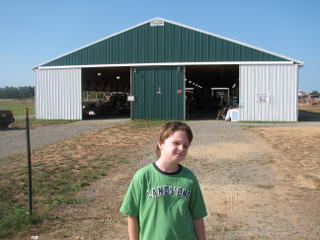
Okay, if you blinked you probably missed it, but two weeks ago, New Jersey held its annual fiber and sheep festival on a gorgeous sunny afternoon. The Harvest Sheep and Fiber Festival is held the fourth weekend in September every year. This year, the festival had the misfortune of being held the same weekend as Stitches, which may have put a damper on attendance. I took the intrepid James (my eldest) along for a ride. He's always up for field trips involving livestock and is generally a good sport when Mom stops to fondle yarn. Here he is at the entrance to the show:
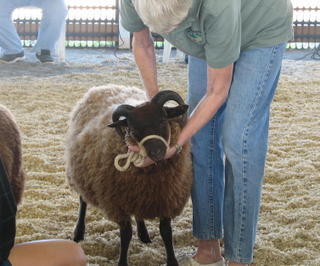
Now if you're thinking this is something along the lines of Maryland Sheep & Wool, or Rhinebeck, you'll be sorely disappointed. We're talking small. Really, really small. But perfect for a seven-year-old with a short attention span and a knitter with an ample stash. We admired the sheep in the show ring. This is a Shetland:
In addition to many breeds of sheep, they had other fiber animals, like this alpaca:
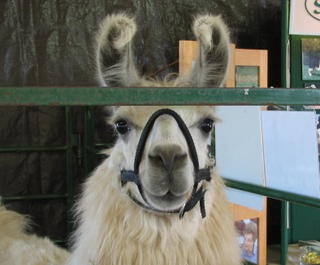
(Did you ever notice what complete hams alpacas are? You can always count on them to bat their eyelashes and smile pretty for the camera.)
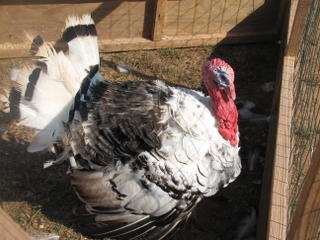
And some non-fiber animals (unless you know something I don't about turkeys):
My son fell in love with some itty-bitty bunnies called Jersey Woolies. Here's one but I don't think the photo shows how absolutely adorable they are:

We're still working on getting Daddy to reconsider the no-pet rule, but so far, it's not looking good.
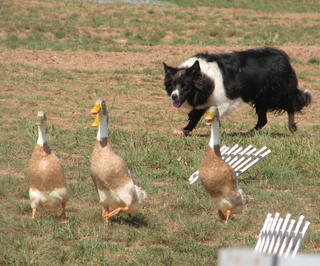
After browsing among some hand-dyed and handspun yarns and fleece, seeing some spinners, and getting the obligatory snack, we watched the sheepdog demonstration. This was Micky herding some ducks:
The Harvest Festival isn't very big in terms of numbers, but it is big on charm. If you have little kids in tow and want an uncrowded, manageable outing, this would be a good choice. Besides, don't you just love the smell of fresh sheep manure in the morning?
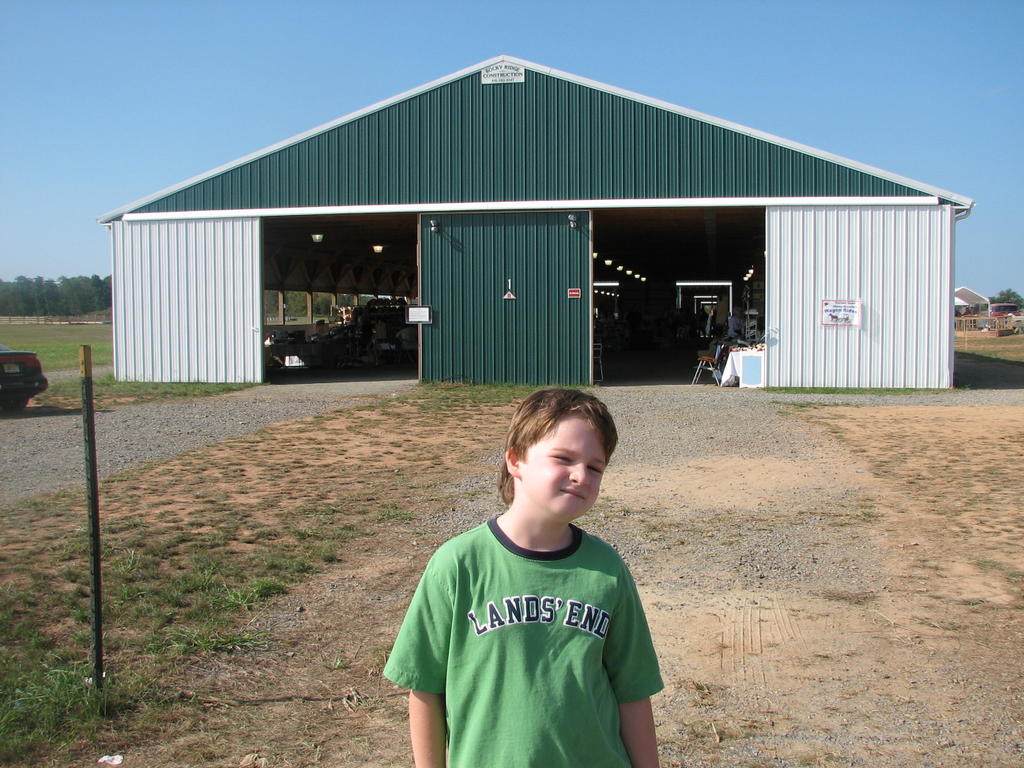
Now if you're thinking this is something along the lines of Maryland Sheep & Wool, or Rhinebeck, you'll be sorely disappointed. We're talking small. Really, really small. But perfect for a seven-year-old with a short attention span and a knitter with an ample stash. We admired the sheep in the show ring. This is a Shetland:
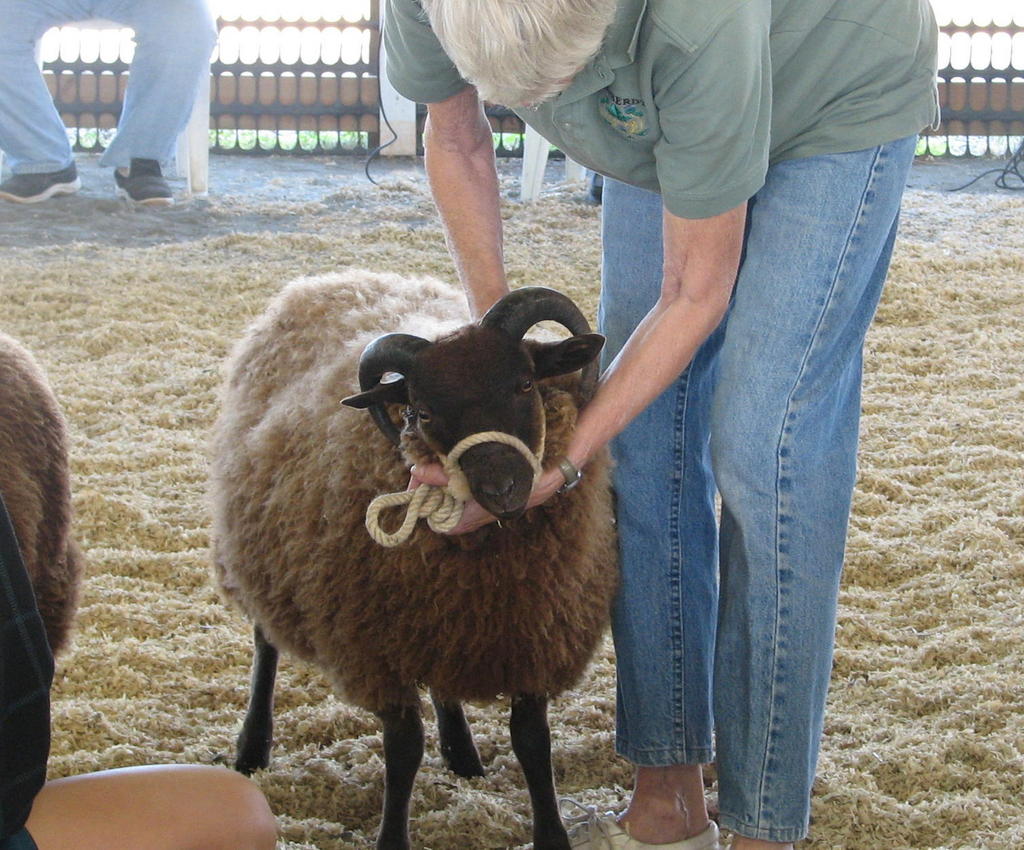
In addition to many breeds of sheep, they had other fiber animals, like this alpaca:
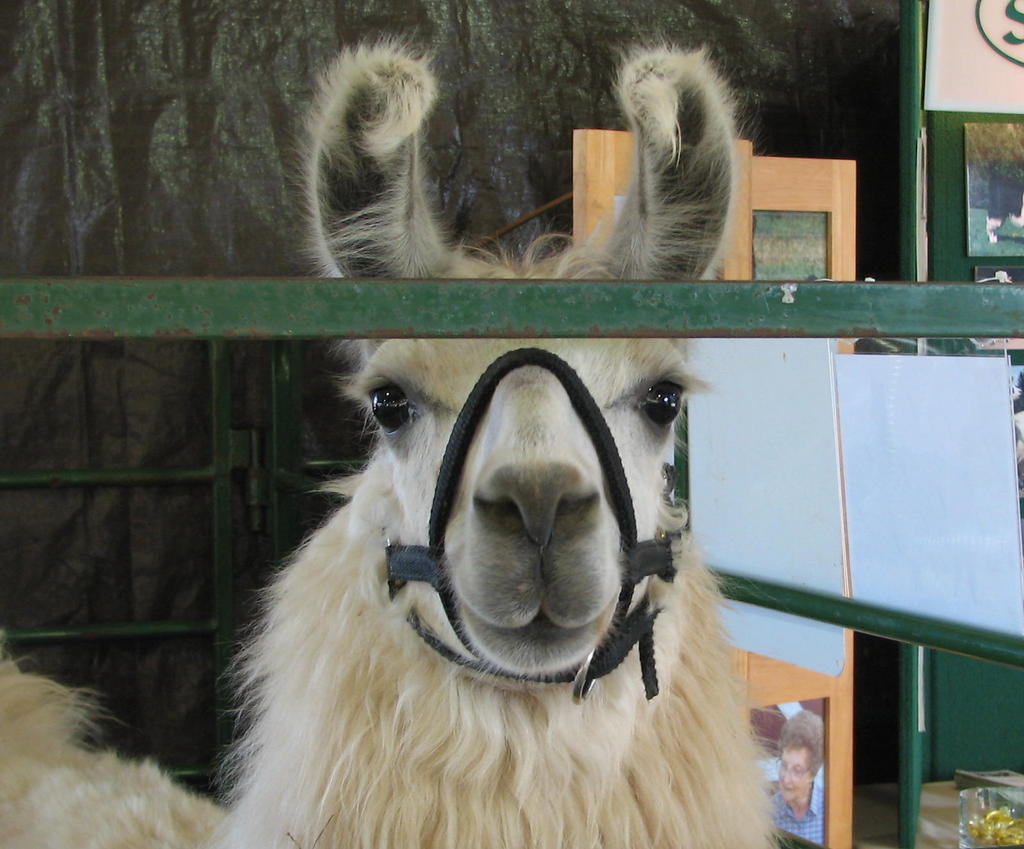
(Did you ever notice what complete hams alpacas are? You can always count on them to bat their eyelashes and smile pretty for the camera.)
And some non-fiber animals (unless you know something I don't about turkeys):

My son fell in love with some itty-bitty bunnies called Jersey Woolies. Here's one but I don't think the photo shows how absolutely adorable they are:
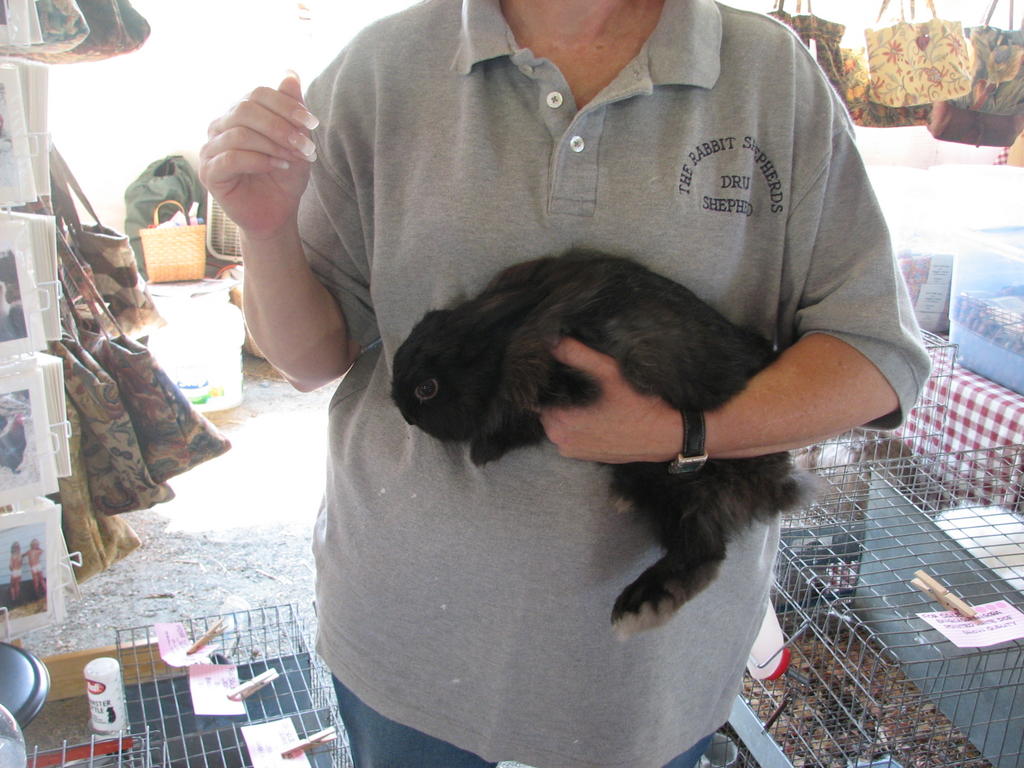
We're still working on getting Daddy to reconsider the no-pet rule, but so far, it's not looking good.
After browsing among some hand-dyed and handspun yarns and fleece, seeing some spinners, and getting the obligatory snack, we watched the sheepdog demonstration. This was Micky herding some ducks:
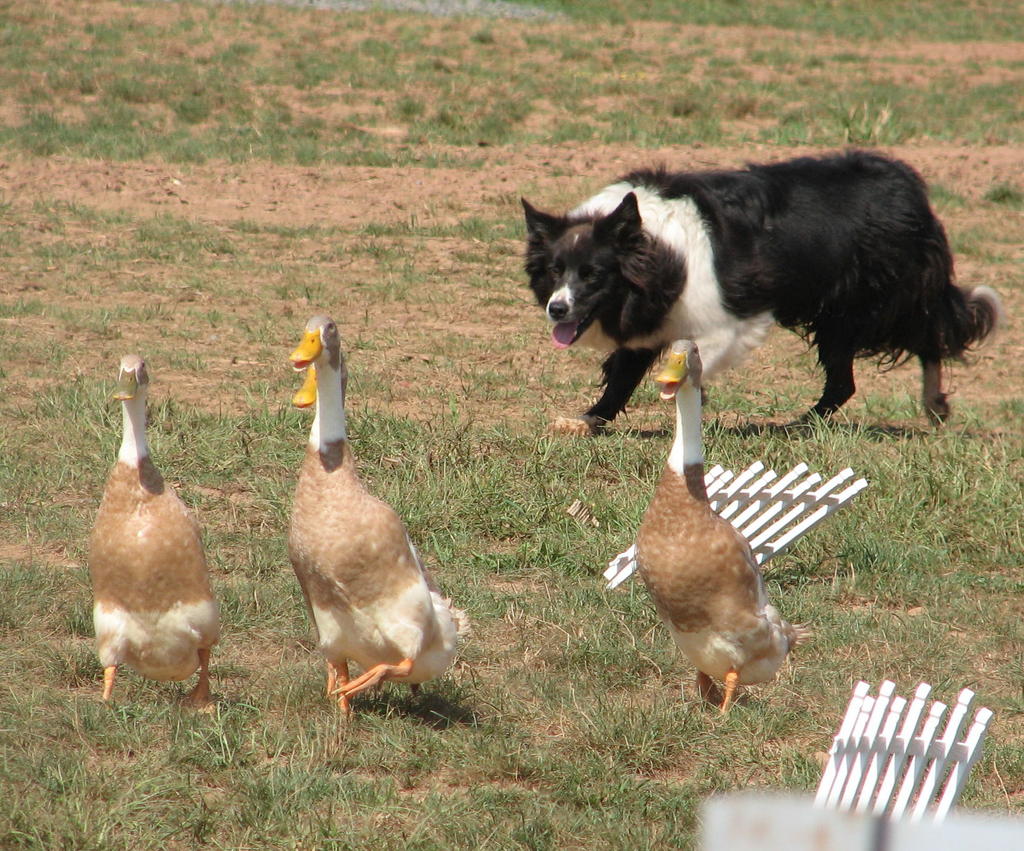
The Harvest Festival isn't very big in terms of numbers, but it is big on charm. If you have little kids in tow and want an uncrowded, manageable outing, this would be a good choice. Besides, don't you just love the smell of fresh sheep manure in the morning?
Subscribe to:
Posts (Atom)