Thursday, May 11, 2006

I've never seen anything like it


Yes, there it is: 6--count 'em, six--virtually identical skeins of Schaefer Yarns Anne. In a lovely colorway, to boot.

Isn't this what's never supposed to happen? We have enough trouble getting Anne in doubles (for large shawls), and we're always on the lookout for triplets (since some people want to make a sweater). And now, suddenly, this!

What to do? I don't know anyone who's been looking for 6. But it seems such a shame to break up the set.

Perhaps we should have a lottery. Or an essay contest: 500 words about your proposed project.

3360 yards. Tablecloth? Bedspread? Dress with matching tights?

Wednesday, May 10, 2006

More images from Maryland Sheep & Wool

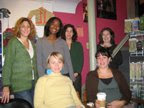
The yarn-starved masses begin to assemble:


Our fearless leader:


Upon disembarking, the Rosie's green backpack is everywhere:


Here's what we came for:


and also this:


Prizewinning entries, including handspun:


a felted objet d'art:


and a lovely fair isle mitten:


See you next year!

Monday, May 08, 2006

Sheep & Wool Festival Report

I'm still exhausted, and I'd rather be playing with my new fiber, but here's a brief recap:

The early bus left on time! (Plus or minus about 3 minutes, which I think is pretty good.)

The late bus left on time!

We did guess right about when the traffic gets bad: although the early bus left only 30 minutes earlier than the late bus, it arrived on the fairgrounds an hour earlier. (Note to self: 7 a.m. departure next year?)

I can't tell you about the melee at the Koigu booth, because I avoided it. Instead, my first stop was to visit our newest colleague, Anna:

She spent the weekend at the Kiparoo Farm booth, because that's what she's always done. She said that people started coming into their booth at 8:10 in the morning--despite the fact that the show didn't open until 9.

Then I headed up the hill to buy a t-shirt for Suzanne. (In a ridiculous coincidence of childcare snafus, involving both a cardiac catheterization procedure and a performance of Lohengrin, Suze wound up staying home on Saturday. Her only request was that I get a t-shirt, since they'd likely be sold out by Sunday morning. As, in fact, they were.) The line for t-shirts and other Festival-logo merchandise was long:

I spent about 45 minutes in it.

Then came the shopping. I bought only two skeins of yarn for myself--more Brooks Farm mohair--and a couple skeins for friends who couldn't make it this year. The rest was all spinning fiber.

I'm not going to show you any more pictures, though, because what struck me this year wasn't the stuff I saw, but what I heard at the Festival:

--Music: harp, banjo, hammered dulcimer, bagpipe, country ensemble with fiddle, recorder.

--Cell phones: I predict that, within three years, no one will be allowed onto the fairgrounds without one. Favorite overheard line: "Can you see me now? I'm the one waving."

--Other bits of conversation: ". . . he's still finishing up his last exam." "Every year, I find you on this same bench." ". . . world-class working dog just herded your wife . . . " "See, honey? He likes me. Now we have to take him home" [said by a guy holding a lamb while his wife shopped for yarn].

--The PA announcer. People who'd left dogs in their cars (don't get me started), people who'd left credit cards at booths, the beginning of various events. And then best of all . . .

--The huge collective sigh of relief, accompanied by clapping and some cheers, that rose from all sides when they announced that the "lost" 4-year old boy they'd been talking about for the previous ten minutes was, in fact, with his mother at the car. ("Security, if you've still got Dad, please bring him back to the information tent.") I always feel like the Festival is about the safest place I ever am in the course of the whole year, but for a few minutes there, it felt like part of the real world.

--And over it all, of course, the incessant baa-ing, near and far.

A lot of this is wasted on the knitters, who seem to go deaf shortly after arrival. My personal theory is that we're so incredibly focused on what we're seeing, and, to a lesser extent, on what we're touching, that there's just no attention left for hearing. But haven't you noticed that you can call someone's name, even when they're only 8 feet from you and there's no one in between, and they'll just completely walk by you? You have to reach out a hand and grab them to get their attention.

So that's my report. We got home on time, and no one was left on the fairground. There is, however, a double-pointed needle, US #7, that was found on the early bus after everyone debarked. If it's yours, please come to the shop and claim it.

Same time next year!

Wednesday, May 03, 2006

Lace Lovers...

...check out the Lace Extravaganza at the Knitting Beyond the Hebrides site. All kinds of interesting stuff going on there, including on-line tutorials and contests.

Tuesday, May 02, 2006

What Spinning Teaches Me About Knitting, pt. 2

Yes, it's been many months since Part 1 of this series, but that's how I spin: irregularly in every sense, with tendencies toward thin yarn and Spring.

Why Spring? I know I'm not alone in looking at last year's Sheep and Wool Festival stash as I see this year's Festival approaching. My goal recently has been to spin something I bought last year before I go to buy more this year.

Toward that end, last week I returned to this:

It moved to the wheel shortly after that photo was taken, and then stayed there unattended for 10 months or so. It's Blue-Faced Leicester from Earth Songs Fiber.

I didn't really remember much about what I'd been trying to do--I know I didn't have a particular project in mind, but was there a weight I was aiming for? I settled for something vague, like "not too skinny."

The roving was dyed quite irregularly, which pleased me, since (if you recall Part 1) one of the things I struggle with in my spinning is the urge to micromanage. If the colors were regular--in sequence or in spacing or anything--I'd be trying to arrange for them to be evenly distributed in the finished yarn, splitting the roving to create two hypothetically equal plies, etc.

Instead, I just sat myself down and started in.

While I spun, two thoughts kept recurring. The first was, "This is only 4 ounces of roving, but it feels like it's taking forever to spin. Isn't that a sign that I'm spinning too thin a strand?"

The second was about randomness. That's what everyone wants in a multi-colored yarn, right? There are so many complaints about what the colors "do" when the yarn is knit up. Do they streak? Stripe? Pool? Zigzag? Unless the design is specifically written around the particular color effect of the particular yarn, frustration is everywhere. Because very few yarns have truly random color distribution: machines may vary how long each color segment is, but seldom the color sequence; hand-dyers work with yarn wound into hanks, which pretty much guarantees some fixed intervals of color.

When I spin from a roving, however, the situation is different. First, roving is dyed (or, more often, painted) as a single long strand. So, although the dyer has the option to use a repeating color sequence, there's no need to do so. And even if the color sequence repeats, the interval doesn't have to--in a sequence like ABCACDABCACDABCACD, each area of B may be larger or smaller than the previous one.

Then there's the question of how I spin that roving. I can pull a short tuft off the roving, and the strand I spin from it may all be virtually the same color. Or I can pull off a longer tuft, then split it lengthwise into 2 or more sections; in this case, I'll get shorter lengths of color, and the sequence of colors from that tuft will repeat 2 or more times before I go on to the next. Or I could split the entire roving multiple times before I even begin to spin, creating multiple repeats of one long color sequence. (There's a spinning project in progress with which I took that technique. I'll show you sometime. There are 2 finished skeins of yarn so far, each maybe 1 ounce, and probably 12 plastic bags with roving in various states of splitting, each with a label like "B4." I started it in May '98 with the idea of knitting a sweater for our first child. I can't imagine why it's not finished yet, can you?)

Anyway, my point is that there are a lot of ways for disorder--randomness--to enter the yarn as I spin it.

So I'm spinning along, making a bobbin of yarn that looks something like this,

and musing upon the word "aleatory" ("subject to unpredictable causes," more or less, from the Latin word for dice), and the next morning, when I come downstairs, I find that the dog has done this with the roving:

Add one more to the list of ways that disorder can enter handspun yarn. (If you'd like your yarn to be less predictable, Truffle can visit your house, too.)

My first thought as I surveyed the wreckage? "Oh, bother, now I have to learn how to Navajo-ply." Navajo plying lets you make a three-ply yarn from one continuous strand, and you have control over where the colors come together, so you can keep the colors distinct or blend them as you prefer. (There's a good illustration here.) Did you notice that word, "control"? This whole letting-go thing really doesn't come naturally for me.

But I figured that the already-not-very-bright colors of the roving were going to merge into mud if I didn't do something to separate them a bit, so I tried it. The results? Much more awkward and messy than you can see here

or here

or here

In fact, it looks kind of cool (as long as you keep your distance), and also when it's wound:


What's it going to be when it grows up? Altogether, the two skeins total maybe 225 yards, and it knits to about 5 to 5.5 sts per inch (on average) on US #6s. I figured that that gauge put me in good shape for some half-fingered gloves. This proved to be a serious miscalculation. But more on that next time.

Sunday, April 30, 2006

OPK (Other People's Knitting)

Jim is almost finished his Sarah Blanch shawl, from Folk Shawls:

(Actually, the picture is more than a week old; he's probably finished it by now.) That's Koigu, of course; the skein in progress is the eighth and final one.

Lisa J. is making another felted entrelac bag:

--this time using leftover scraps of Kureyon that she had around the house--there are at least 4 different colorways in there. (Any of you out there have bits and pieces of Kureyon lying around? Nah, I didn't think so.) Note the spots where stitches are picked up to start a new rectangle, and the old color shows through along the pick-up line:

This will all vanish entirely when the bag is fulled.

And Marian has made the most amazing felted rabbit:

"Real" stuffed-animal eyes and everything!

Finally, Robin's Rambling Rows baby blanket is done, done, done!

Don't you think she should only give it to the baby on condition that she can still visit it from time to time?

Friday, April 28, 2006

This may be a bit premature, but....

according to Weather.com, forecast for next Saturday (Maryland Sheep & Wool Festival) is partly cloudy, with a high of 72 degrees. Sounds like perfect sheep-petting weather to me. Last one to the Koigu booth is .... an unhappy camper!

Sunday, April 23, 2006

Specs

For anyone who saw the last post and wondered about how to improvise a Faroese shawl, here's what I did:

I measured one long bottom side of my shawl (that is, from the edge of the center panel out to one corner): in this case, something like 50". I reduced that to about 32", figuring that perhaps the correct proportion for this measurement is a-little-less-than-the-wearer's-height. [Error 1: my shawl was still too big for Diana, or at least that size done in bulkier yarn was overwhelming for her.] I then multiplied that by the gauge of the new yarn, about 5 sts per inch: 160 sts. [Error 2: The new gauge from which I calculated was based on the Koigu with which I cast on, but more of the shawl came from the DK-weight yarns than I'd anticipated, so the gauge was bigger than I expected, approximately 3.5 sts per inch.]

Took the same measurement and calculation for the bottom edge of the center panel. 7", reduced it (pretty randomly) to 6, 30 sts. [No errors here. At least, none that weren't covered in Error 1 and Error 2.]

Put a 5-st border at each side, for a total cast-on number of 360 sts.

Measured my shawl from cast-on edge to center back neck, compared that length to the distance from the back of Diana's neck to her tuches, reduced accordingly, and converted that to a row-count for the new yarn. 20" reduced to 16" times 10 rows per inch = 160 rows. [Error 3: I always assume the standard 2-to-1 ratio for garter stitch, i.e. if 5 sts = 1" then 10 rows = 1". But loose knitting and strong blocking, both so common in lacework, throw that off, until the vertical gauge can be much like that of stockinette (maybe 7 rows per inch in this example).]

Now, a word about how Faroese shawls are built: The obvious shape is a center-back panel that tapers upward (though not all the way to a point), flanked by two wide triangles. The usual method is to cast on at the bottom and then work upward while decreasing. The side triangles decrease (for the most part) in an easy and steady way: on every right-side row, a decrease is made at the beginning and end of each triangle. In the example here, that would mean 2 decreases every 2 rows in each 160-st triangle, so it should take 160 rows to reach the top.

The coincidence of this number matching the row calculation I reached above should look wonderful, but that would overlook the other, less obvious, shaping of a Faroese shawl: it has additional decreases in both the side and center areas, placed relatively near the top, which draw the "wings" in somewhat and make the shawl sit happily on the shoulders (instead of sliding off, as plain triangles tend to do).

An examination of my shawl and a few other shawl patterns gave me the notion that these supplemental decreases tend to start when about half the triangle stitches have been decreased, tend to occur about three times altogether, and tend to involve between 10% and 15% of the existing stitches. In this case, that would mean that there would be a row of extra decreases when there were 80 sts left in each triangle.

I (of course) have no notes about this process, so I have no idea what I was thinking, but examination of Diana's shawl indicates that I in fact worked 4 decrease rows, and that the first one decreased 6 sts, the second one 5, the third one 7, and the last one 4 sts.

Error 4: An astute observer might now remark that each of these decreases diminishes the number of rows needed to get to the top: thus, instead of the projected 160 rows, I'd be looking at more like 138. And indeed, Diana's shawl only has about 130 rows. But this error (which would make the shawl come out too short) actually compensates somewhat for Error 3 (which was going to make the shawl too long). The total length is about 16".

How does the center panel decrease? Many Faroese shawls have lace patterns up the center panel, and the requirements of the pattern dictate when and where the decreases occur. For this plain one, I worked the first decrease row at the same time as the first set of supplemental decreases at the sides, and I did a total of 6 decrease rows (three having 3 decreases each and 3 having 2).

To summarize the knitting thus far:

Cast on 360 sts. Knit 1 row, placing markers after the 4th stitch, the 165th stitch, the 195th stitch, and the 356th stitch. (If I can count, that should bracket the center 30 sts and set off the outer 4 on each side.)
Row 1: K4, slip marker, ssk, k to 2 sts before next marker, k2tog, k to next marker, slip marker, ssk, k to 2 sts before last marker, k2tog, k to end. 4 sts decreased.
Row 2: Knit.
Repeat rows 1 and 2 until 81 sts remain in each outer section.
Next row: K4, *slip marker, ssk, (k9, k2tog) 6 times, k to 2 sts before next marker, k2tog, slip marker,* (k6, k2tog) 3 times, k to next marker, repeat from * to * once more, k to end. 19 sts decreased: the usual 4, plus 6 in each triangle, plus 3 in the center. 73 sts remain in each triangle.
Knit 1 row.
Now go back to repeating rows 1 and 2 again until there are 63 sts in each triangle.
Next row: K4, *slip marker, ssk, (k8, k2tog) 5 times, k to 2 sts before next marker, k2tog, slip marker,* (k5, k2tog) 3 times, k to next marker, repeat from * to * once more, k to end. 17 sts decreased: the usual 4, plus 5 in each triangle, plus 3 in the center. 56 sts remain in each triangle.
Knit 1 row.
Repeat rows 1 and 2 twice more. Then work a row with the usual side decreases, plus 3 sts decreased more-or-less evenly throughout the center section.
Continue on until there are 48 sts in each triangle.
Next row: K4, *slip marker, k2tog, k3, (k2tog, k4) 6 times, k2tog, k to 2 sts before next marker, k2tog, slip marker,* (k6, k2tog) twice, k to next marker, repeat from * to * once more, k to end. 20 sts decreased: the usual 4, plus 7 in each triangle, plus 2 in the center. 39 sts remain in each triangle.
Knit 1 row.
Repeat rows 1 and 2 twice more, then work a row with the usual side decreases plus 2 in the center section.
Continue on until there are 33 sts in each triangle.
Next row: K4, *slip marker, k2tog, (k4, k2tog) 4 times, k to 2 sts before next marker, k2tog, slip marker,* (k4, k2tog) twice, k to next marker, repeat from * to * once more, k to end. 14 sts decreased: the usual 4, plus 4 in each triangle, plus 2 in the center. 27 sts remain in each triangle.

Back the the theoretical part:

From here it gets a little dodgy. My original shawl does this cool thing where the remaining stitches in the center section suddenly start to decrease by tapering inward from the sides, fast (like decrease-on-every-row fast). I assumed that this was typical, and duplicated it for Diana's. So after the most recent set of center-panel decreases, there were 13 sts remaining. I waited until I thought I was six rows from the end of the side triangles--which would be when there were about 7 sts left--and then began to decrease the center by working (ssk, k to last 2 sts, k2tog) between the center markers on every row.

Special note for the final decrease row in each section: when there are only 3 sts remaining in any section, work a double decrease (slip 1 st, k2tog, pass the slipped st over) to reduce them to one.

With any luck, this has brought everything to a point, and there are 4 sts outside the markers, plus 1 st in between each pair of markers: 11 sts. Option 1: rearrange the sts onto 2 needles and work a 3-ndl bind-off from outside edge to center, working the last 3 sts as "k3tog" instead of the usual "k2tog." Option 2: Rearrange the sts onto 2 needles and stare hard at them until you remember how to work a garter-stitch graft. (Hint: perhaps it would help to knit the first half of the row and then graft from the center out to the edge.)

After you have your second kid, you get a little less obsessive. (Or maybe "more chaotic" would be more accurate.) By the time I got to Eva's shawl, I'd noticed my own tendency to want to work more shaping and make things more complicated. This time, I only did 3 supplemental decrease rows in the outer triangles, and I decreased the center panel gradually but kind of randomly, working "ssk, k to last 2 sts, k2tog" every 4th row for awhile and then more-or-less every 2nd row until I ran out of sts at the same time as the side triangles ended. I also made what I think of as the "Landscape Shawl Modification": instead of decreasing on every right-side row, I decreased on every row, but only for the first half of the row. That is, I'd begin each row with "k4, ssk, k to 2 sts before next marker, k2tog," then knit the rest of the row plain. This keeps you from having to think about which is the right-side row, which can sometimes be a nuisance with garter-stitch. No one's every going to notice that the decreases on one side are offset by a row from those on the other.

Stripes and Yarn Requirements

All the stripes are in multiples of 2 rows (or 1 garter ridge), so that the color-changes are clean and the yarns can all be carried up one side edge. (A meticulous mommy might work a round of single crochet around the edges to hide all that, but I'm not that mommy. And even Eva, who complained about the ends sticking out, has nothing to say about the stranding up the side.) Diana's shawl was in 4-row stripes until I realized that neither the Koigu nor the Snuggly (which was, of course, the last skein in the world of a discontinued color) was going to be sufficient. Then I started mixing things up a bit, introducing the new green with a 2-row stripe and rationing the old green so that some of it continued all the way to the top. The next multi after the Koigu ran out was a skein of Regia (Ringel, I think, in a color that may have been called "Clown"), and I finished up with some Stahl Baby Color (is that stuff even made anymore?). There are 4 entire 50-g skeins in there, varying in yardage from about 175 to about 225, plus some more.

Eva's shawl used Debbie Bliss Baby Cashmerino (the raspberry), Dale Baby Ull (the turquoise), Peter Pan DK (the royal blue), and Fortissima Socka (the purple), all on US #4 needles, for an overall gauge of about 5 sts per inch and a cast-on number around 280. This time, I'd started with full skeins, and I knew what they were, so I was able to calculate the yardage: about 380 altogether. The colors always repeat in the same sequence, but the stripes are on a repeat of 3 (4 rows, 4 rows, 2 rows) to liven things up a bit.

The depth at back-of-neck on Eva's shawl is only 13", and the wings each measure maybe 25" from center corner to tip. There's a kind of pattern to the sizing here: I generally knit large for Diana, with the usual knitter's impulse to have her get the most wear out of it, and I often overdo it, as here. Then, when I knit for Eva, I overcompensate--not only because I don't want it to be too big again, but because I figure it doesn't need to fit for that long, since she'll inherit her sister's soon enough.

If these instructions seem too vague, take my advice: make a flying guess at a cast-on number and dig right in; figure the rest out as you knit. It's a shawl, after all, and exact measurements and shaping aren't crucial. Wing it. If you get stuck, come find me, and I'll bail you out. It's all a lot easier than it looks.

Wednesday, April 19, 2006

Spring Shawls

The first shawl I knit in Zephyr was a Faroese shawl from Knitters magazine. It came out a little smaller than the original, which taught me a little something about blocking and merino, but it was a perfectly fine size, considering that I have a few (!) other, larger shawls for when I want larger:

My notes say it was completed sometime in 1998.

(I don't keep good notes about most of my projects, but the bare-bones list of what I've knit now goes back to the early 1990's. But that's a post for another day.)

Some time ago, in a moment of unanticipated chill, I lent the shawl to Diana for a few blocks. She was still little enough then to be tickled to be wearing Mom's stuff. In fact, she liked it so much, she asked me to knit her one.

Hah. I'm dumb, but I'm not that dumb. No way was my kid getting a lace shawl in laceweight yarn. I let her pick out a color or two of DK-weight yarn, combined it with some stuff from around the house, and made her a Faroese-style shawl. As I knit, I could feel the ghosts of Faroese knitters of centuries past looking over my shoulder and shuddering at the acrylic baby yarn in greens Mother Nature never dreamt, but y'all know Diana and her thing for green:

It was huge for her at the time--I finished it sometime in 2003, when she would have been 4--so it didn't really get much wear until this Fall.

Then came a windy day when Eva saw Diana and me wearing our shawls, and the inevitable happened. In an almost unprecedented display of promptness, in fact, it happened within the following six months:

Apparently Eva doesn't like multicolored yarns; I set more than a dozen different kinds and colors out for her to choose among, and she avoided all the multis in favor of these. Even when I suggested including just one. Now, of course, she announces that she likes all the colors except the purple. Oh, and the ends on the inside: she doesn't like the yarn tails sticking out. (The yarn tails stick out, Short Stuff, because I know you're going to drag this thing all over the neighborhood, use it as a doll blanket, tie it in knots--if I cut the ends off flush, they'd be poking out everywhere in a week.)

This shot

is the photo of record, because, while Suzanne is high on the list of upcoming shawl recipients, the Faroese shape just doesn't seem best for her. (I could be wrong. I've been swatching some Brooks Farm mohair from last Sheep and Wool Festival, and it's a vaguely Suzanne color, and it may be headed for the Litla Dimun from Folk Shawls. But it may not, and anything that sheds--boy, does this stuff shed!--may not be a Suzanne yarn.) So don't hold your breath to see all four of us in coordinated Faroese shawls.

Tuesday, April 11, 2006

You Asked for It

Since crochet is all over the place this season--all over ready-to-wear, all over the slew of new books and magazines, encroaching on knitting magazines from Rowan to Family Circle--we're going to offer a multi-week Beginner Crochet class.

It's the equivalent of the Beginners Knitting class: 6 weeks, a few small projects to show you plenty of techniques, all materials included. It starts on Monday 4/24.

Here are the things we'll be making:

At upper right, a cotton facecloth. At upper left, a drawstring bag. Front and center, a gauntlet (not in this too-hot-for-summer, too-hard-to-rip-out angora, but you get the idea). On the gauntlet, a simple flower, to decorate the gauntlet or the bag or anything else. At the extreme upper left, you can catch a glimpse of a granny-square pillow; if time allows or if interest demands, we'll look into granny squares, too.

If you've taken the one-day Intro to Crochet class, you'll be ahead for the first week and a half or so, but then we'll be on to new territory.

There's no avoiding the c-word this summer, so why not get on board?

Thursday, April 06, 2006

New Books

Because these eagerly-anticipated titles came in yesterday afternoon, too late for the newsletter, I thought I should tell you:

and

and this

are here.

Wednesday, April 05, 2006

Knitting, Anyone?

Oh, you mean we're supposed to show you actual knitting in a knitting blog? Well, if you insist:

Sara in the Intermediate Class finished her gauntlets:

After the picture was taken, I swear she wove in the ends.

And I've been working with some hand-dyed yarn from a new supplier, Black Bunny Yarns:

Here's more of the yarn:

It's a bulky-weight wool; I'm getting about 3.5 sts per inch on the hat, closer to 4 on the mittens. You can make both (there are also instructions for the mittens in a larger size, these are larger than they look and fit my hand, but that's not everyone) from one skein, which is $25. The skeins have names like "Swimming Pool" and "Water Ice" and "Campfire" (the hat is "Jar of Olives"), but that's just these specific skeins, not the name of a colorway: when the label says, "Each batch is unique," it's not about the typical variation of hand-dyed yarn. It means the dyer has no intention of repeating herself and won't be trying to make the same color twice. You've got to come in and see them.

Actually, you really have to come in and see them: this stuff isn't available anywhere else.

While I've been home with my sick kid, I also finished this Daisy Top:

It's kind of hard to see, even in this closeup,

but the yarn itself has little white "daisies" on it. It's from Katia, and it's called Margarita. I assume "margarita" means "daisy" in Spanish; "marguerite" does in French, right? (Which is apparently why Daisy is a common nickname for Margaret, something I'd really wondered about.)

You can't tell much about the size from here, but it's a children's 6; the pattern goes from 2 to 8. I hope to get a kit onto the website soon.

I know I should be showing more progress on my Lace Sampler Scarf, but no needle smaller than an 8 is thinkable while watching "Barbie Swan Lake." (The things we do for a sick kid.)

Sunday, April 02, 2006

Great trunk show

The Wrap Style trunk show just arrived at Rosie's and it's terrific. If you liked the projects as they look in the book, you should see them in real life. Shirley Paden's lace capelet is my personal favorite; it looks like cobwebs in the moonlight. Exquisite. The argyle wrap is adorable (we tried to get a photo of Mary B. modeling it, but due to technical difficulties...) The felted wrap with detachable fur collar really makes you start to think about the possibilities of felted colorwork. And there are many more. Stop by when you get a chance and admire some of these beauties, even try them on.

Tuesday, March 28, 2006

Birth of a Knitter: Episode 2

It seems that the leap from knitter to designer is, for better or for worse, a short one:

A cousin gave Diana a knitting kit for Hannukah (my favorite spelling, by the way, just for its retro look). She's doing the scarf first. And, since she thinks someone else might want to make one like it, she's written up the pattern. I wish, oh how I wish, I could show you the original handwritten version; but I can't get the contrast right and nothing shows up. I can show you the typescript she made from it, unedited:


The Acrylic Scarf
By Diana Myers
Your friend will love this extra long that
is so easy to knit!


Size
3 feet 36 inches


Materials:
U.S. 6mm size 10s
1 ball encore(shown in blue)
1 darning needle

Pattern Abbreviations: sts= stitches
Cast on 18 sts
Knit 36 inches.
Measure constantly.
Bind off.

Here’s how if you’re a beginner:

Knit 2 stitches as if you are beginning a row. Slip the bottom one off without letting the other stitch off the needle. Knit another stitch. Continue until 1 stitch is left. While you are doing this the scarf will get heavier. Cut the yarn away from the scarf, but from the ball of yarn. Don’t make it too long! Slide the stitch off the needle. Put yarn end through the stitch. Be sure it’s not the cast on
tail! Pull end in. Weave in ends.(Both)


FRINGES:

Cut at least 54 8 in. fringes.
Find a place for 4 fringes. Put all 4 fringes into that place. Knot the 4 fringes [not together out of the place] but in the place. Continue doing this until you have done 30 for 4 fringes.

Thursday, March 23, 2006

Update:

Remember this?

It's bigger now.

Also, it's been wet-blocked: fully soaked and then stretched and pinned.

Though I obviously still have a lot to learn about photographing lace, I think most people would agree that the prettiest stitch so far is the fourth one from the left, the one that might look vaguely like rows of umbrellas if you turned your head sideways and squinted a bit. That's the one we'll be starting with in class tonight.

Toward the right end of this half, where things start to go all blurry, is the section that's been knit since I did the blocking. I find that, the better lace looks while it's on my needles, the more apt I am (paradoxically) to forget how much better it will look after it's blocked. When it looks bad, I keep reminding myself that it's going to improve; when it looks good, it seems unlikely that it's going to look better. But it always does. (All you lace-class students getting the hint here? Yours is going to look better, too. More better than you can anticipate right now.)

That big complicated diamond-shaped thing in the center of the last photo? That's the Trellis Diamond from Shirley Paden's "Wrapped in Tradition" in Wrap Style, which we're trying out at Wendy's request. (Hint to all you lace-class students: got your eye on a specific project? It's not too late to suggest other stitches for us to try out. It is a sampler, after all.)

Meanwhile, Robin's got the edging going on her Rambling Rows:

The consensus is that the color could not be more perfect. And now she's got lots of nice, mindless knitting for her upcoming plane trip.

Tuesday, March 21, 2006

Finally!

With just a few ends to weave in, the Jamaica kids' sweater is finally done.


It was a quick knit; it only seemed to drag on forever in my mind, because I kept waiting for a time when I felt fresh enough to tackle the finishing without the fear I'd be too braindead to do it right. Pattern is forthcoming...

Friday, March 17, 2006

Robin's Rambling Rows, & an Entrelac Bag

Every last square is knit:

Which brought Robin, and several others of us at Knitting Circle, to the brink of the final decision:

What color to use for the edging?

The blue-green Koigu along the upper-right edge had been the original plan, but not everyone thought it was perfect; it seemed maybe a little dull, maybe a little too blue. There were quite a few constraints--pardon me, parameters--to the choice, as well: vaguely the same gauge, washable, preferably gender-neutral. (The recipient is a boy baby, but he may someday have siblings.)

The ultimate winner was the pale green Koigu along the upper-left edge. If you don't agree that it's the best, please feel free to say not one word about it: everyone knows computers don't show color accurately, anyway.

And if you've got time on Sunday, you should come down and make your own one of these:

(For those of you who know my issues with felting, Jen did this one.) Class starts at 1:00.

Thursday, March 16, 2006

Turnabout

And now, please join me in wishing a happy birthday to my friend and colleague Carol. With three little kids, she still manages to spin the yarn, dye the yarn, knit the yarn into a garment of her own devising, work in the shop part-time, edit Rosie Knits patterns from home, return e-mail within 15 minutes no matter what time of day or night, write a witty and informative blog of her own, and maintain her sense of humor.

(Though perhaps her biggest achievement this year was persuading Tom to allow a pet into the house.)

Best wishes for a great day and wonderful year, Carol!

Monday, March 13, 2006

A special message for Mrs. Myers

Dear Mrs. Myers,

I know it's not easy being pregnant -- the morning sickness, backache, and all those other unmentionable symptoms -- and I know it's even harder going through labor (oy!), so on behalf of the staff and customers of Rosie's Yarn Cellar, I would like to thank you for giving birth to Lisa however many years ago today it was. Lisa is an amazing woman and her personality, her intelligence, her sense of humor, and of course, her knitting prowess make Rosie's the special place it is for all of us.

Happy birthday, Lisa!

And thanks, Mrs. Myers.

Thursday, March 09, 2006

Meet Dolly


She's another one of the projects we'll be doing in the Intermediate Class.

She's not finished, of course, but I can't tell how far from finished she is. I have a shawl on needles, her skirt isn't fastened in back, she'll need a blouse or vest or something . . . .

Thanks, though, to all at Knitting Circle this evening who advised on hair color. This was clearly the best choice. (I'm still thinking about ways to incorporate the orange eyelash.)

P.S. Because it's "Blog Against Sexism Day" (or was until an hour ago), let me take this opportunity to remind you: if you see a man in a yarn shop, don't assume he's buying a gift for his mother or waiting for his girlfriend.

Friday, March 03, 2006

Welcome Back, Patti!

It's not that we haven't always loved Great Adirondack yarns. It's just that they were very hard to buy, for us: no sales rep, no functional color cards, and when we'd see them in person--Stitches, MD Sheep and Wool Festival--we'd be overwhelmed by the crazy, feathered, sequined ones that grab all the spotlight.

Now, however . . .

. . . they're back. This photo is the colorway called Kenya. (My monitor is showing the purple tones a little bluer than they really are--think blue, green, and plum.) The yarns you see are Sirino (a fingering-to-laceweight silk/wool, 675 yds, upper right), Soxie (merino, 360 yds, left), and Silk Delight (100% silk, 263 yds, foreground). Here they are in Paprika:

No time right now to photograph the other colors, or the Nassau (silk/cotton) or Silk Noir. Silk Noir is an old favorite: if you've ever looked at the Landscape Shawl here in khaki and mauve tones, that's Silk Noir. It's a raw silk, not shiny, kind of rough-looking. 900 yards in the skein is enough for the shawl; $30. Or maybe that Lotus Blossom shawl from Fiddlesticks?

Those of you who aren't within driving distance, my apologies: you won't find these for sale on the website. I'm not trying to tease you. I've just learned the hard way that selling hand-dyed yarns online is a quick road to misery.

The next sound you hear will be the staff scratching and clawing one another for the chance to knit the shop model Clapotis out of the Silk Delight.

Thursday, March 02, 2006

TiVo Alert

This Sunday, March 5, at 3 p.m., the Oxygen network is going to premiere a new knitting show. This episode features Adina Klein (an editor at Vogue Knitting) and Lily Chin. Whatever you think of the specific personalities (and let's keep those comments clean, please!), it should be worth checking out.

Oh, and the stuff in boxes we can't find room to unpack right now includes Nicole (from Adrienne Vittadini, with the new Spring Vittadini pattern book), Classic Silk (from Classic Elite, blended with viscose and linen, with a raw-silk look), and Candy (the hit Artful Yarn from last year, with a bit of elastic).